The Kinetic Cockpit: Where Your Body Becomes the Engine
In the world of high-performance racing, we often fetishize the "motor." We obsess over the paddle blade shape, the carbon modulus of the shaft, and the hydrodynamic efficiency of the hull. But there is a glaring oversight in how most paddlers approach their craft: they treat the deck of the board as merely a floor to stand on. This is a critical error. In reality, the deck is your cockpit, your power-transfer junction, and the foundation of your entire kinetic chain. If you are standing on a flat, featureless slab of EVA foam, you are not maximizing your performance—you are actively hindering it.
Section 1: The Anatomy of an Energy Leak
To understand the necessity of the Ergo-Lock™ system, we must first look at the biomechanics of a paddle stroke. A perfect stroke doesn't start at the hand; it starts in the feet, travels through the core, and exits through the paddle. When you drive your paddle into the water, you are applying massive rotational torque. If your feet are not locked into a stable, ergonomic platform, your body must subconsciously initiate "micro-compensations." You clench your toes, tense your calves, and shift your weight to stay balanced against your own torque.
This is what we call an "Energy Leak." These micro-adjustments are invisible, but they are incredibly taxing. Over the course of a 15-mile crossing or an hour-long race, these small muscle spasms accumulate into profound systemic fatigue. You aren't just tired from paddling; you are tired from trying to keep your body stable on a surface that doesn't support your natural skeletal alignment.
Section 2: The Ergo-Lock™ Biomechanical Geometry
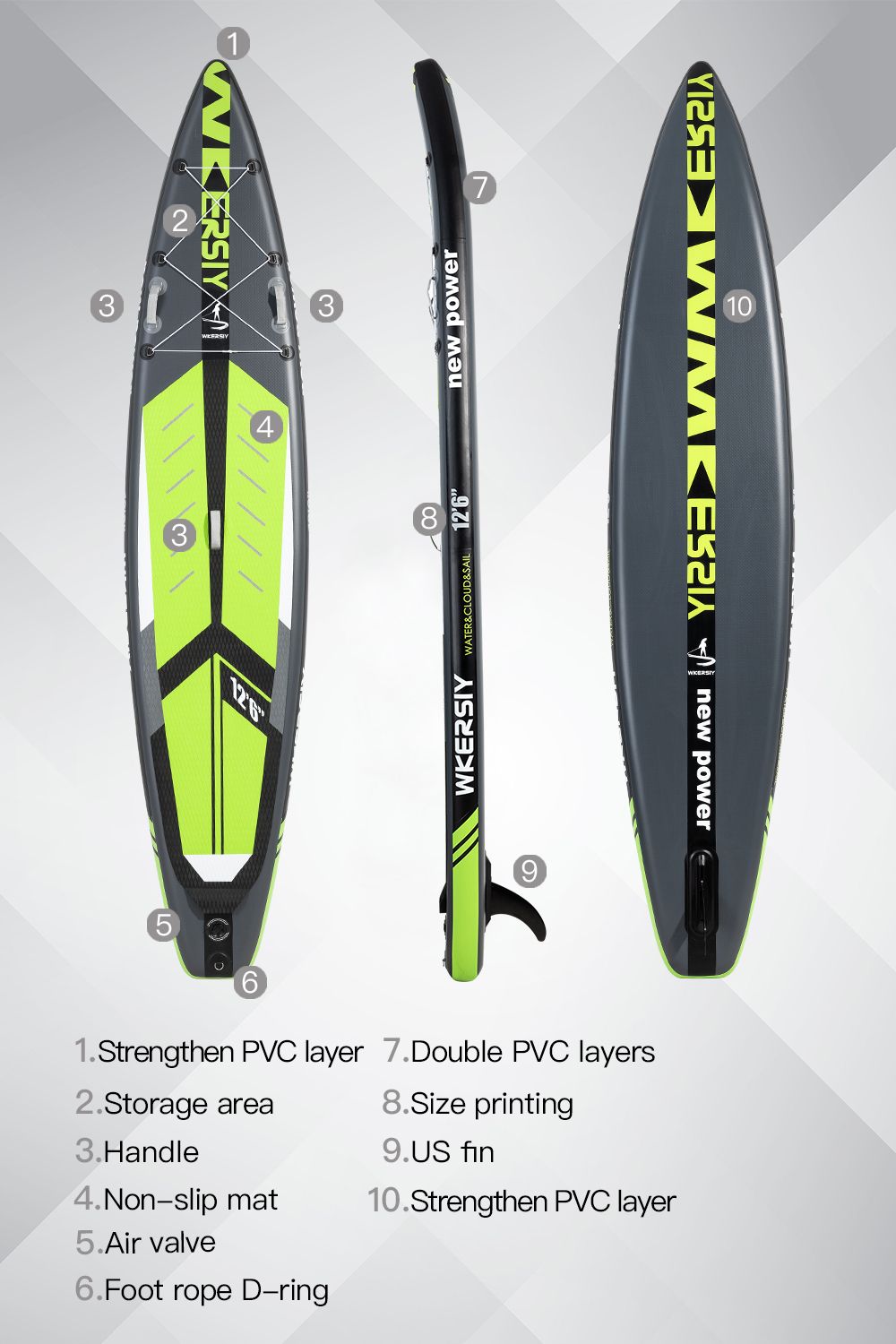
We designed the RockerWave Ergo-Lock™ system to be the antithesis of the "flat deck" philosophy. By integrating 1.5-degree medial wedges that follow the natural contour of the human foot, we’ve created a platform that works with your anatomy rather than against it. These wedges are placed precisely at the pivot points where your feet naturally exert force during a stroke.
The result is a "lock-in" effect. Instead of having to "grip" the board with your toes, your feet are cradled in a natural, relaxed, yet high-leverage position. This allows for a more relaxed ankle, which in turn allows for looser calves and more fluid hip rotation. When your hips are loose and correctly aligned, your lower back is protected, and your latissimus dorsi can fire through the full range of motion. You are no longer fighting your board to stay upright; you are utilizing the board as a rigid partner in your kinetic chain.
Section 3: From Passive Platform to Performance Cockpit
The transition from a passive deck to a Kinetic Cockpit changes your entire relationship with the water. When you have a dedicated ergonomic stance, you stop thinking about "balance" and start thinking about "projection." You can lean into your stroke with absolute confidence, knowing that the deck will catch your weight and translate it into forward motion. It’s the difference between pushing a stalled car on gravel versus pushing it on asphalt. The Ergo-Lock™ system is the "asphalt"—a high-friction, high-leverage interface that ensures no watt of energy is wasted.
Section 4: The Endurance Advantage
This is where the race is often won. In the final quarter of a race, when lactic acid is flooding the muscles, the paddler with the most efficient kinetic loop will always outlast the one who is still fighting their board for stability. By reducing the neurological load required to maintain balance, we keep your stabilizer muscles fresh. We aren't just building a board; we are building an endurance machine that protects your body from unnecessary wear.
It’s time to stop standing on a floor and start operating from a cockpit. The Master Series is designed for those who understand that in professional racing, every detail is a performance multiplier.
Transform your endurance game. Browse our race-ready lineup and experience the Ergo-Lock™ difference at RockerWave.com.