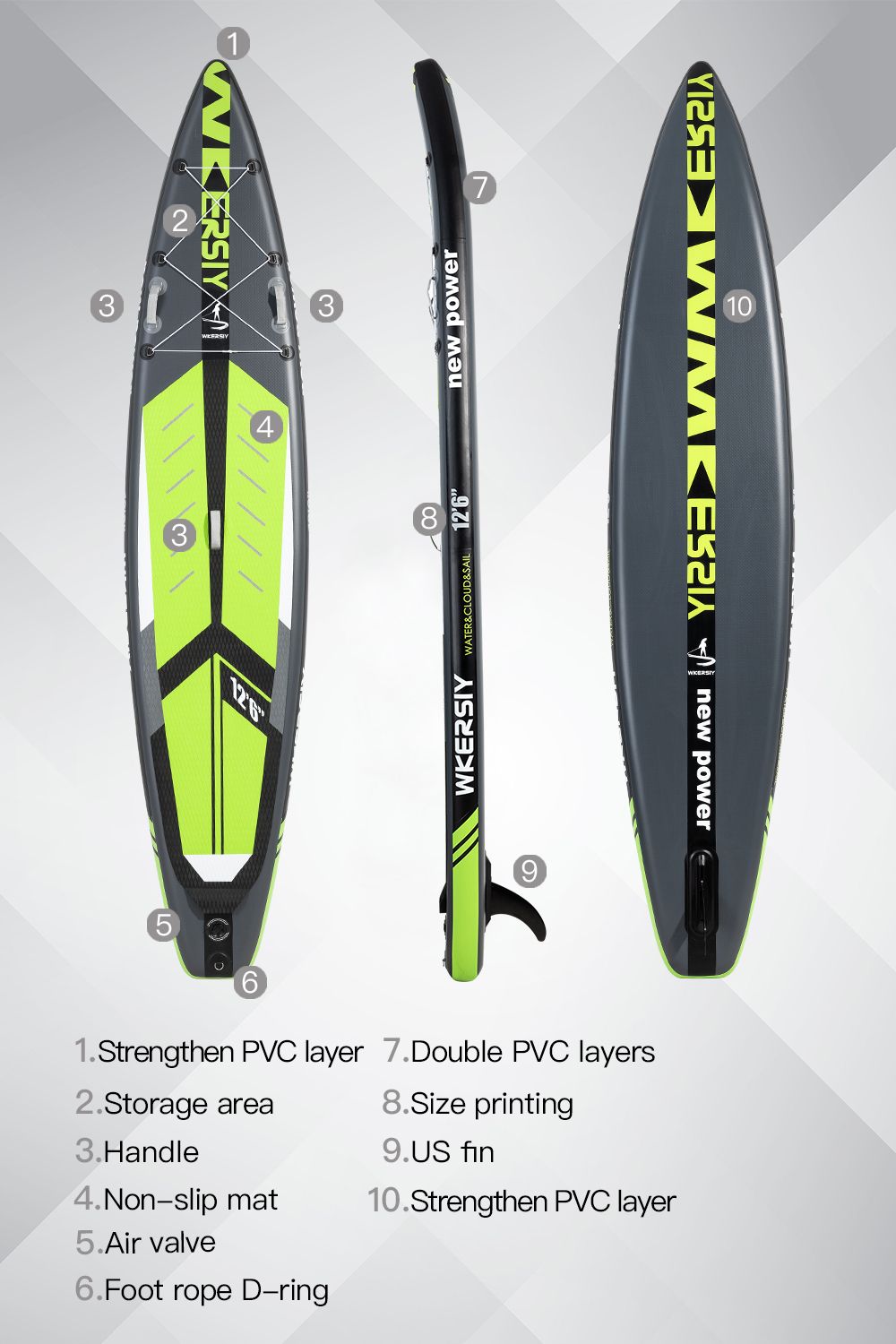
The Fluid Mechanics of the "Catch": Managing Unsteady Flow for Instantaneous Propulsion
In high-frequency racing, a paddle board does not move at a constant velocity. Instead, it exists in a state of perpetual micro-acceleration and deceleration. At RockerWave, our R&D focus for the Master Series has shifted from steady-state hydrodynamics to "Unsteady Flow" mechanics. Understanding how water reacts to sudden force impulses is the secret to a more efficient "Catch" and a longer "Glide."
1. The Vortex Shedding Phenomenon
Every time your paddle enters the water, it creates a high-pressure zone in front of the blade and a low-pressure vortex behind it. Inferior boards with flat, non-contoured hulls suffer from "vortex interference," where the turbulence from the paddle stroke clings to the board's rails, creating a sudden braking force. The RockerWave Master Series utilizes a progressive chine design that sheds these vortices laterally. By accelerating the shedding process, we minimize the "drag spike" that occurs at the beginning of every stroke, allowing for a smoother transition into the power phase.
2. Added Mass and the Inertia of Water
When you accelerate your board, you aren't just moving the weight of the carbon fiber; you are moving a volume of water known as "Added Mass." This water sticks to the hull and increases the effective weight of your board by up to 20%. Our engineers have optimized the displacement hull's entry angle to "decouple" this water volume more efficiently. By reducing the added mass coefficient, the Master Series requires less initial torque to reach planing speed, preserving your fast-twitch muscle fibers for the final sprint of the race.
3. Wave Interference and the Bow-Wave Sync
At terminal velocity, the bow wave generated by the nose can interfere with the tail’s release. We use Computational Fluid Dynamics (CFD) to ensure that the wavelength of the bow wave aligns perfectly with the board's length at professional cadence speeds. This creates a "constructive interference" effect, where the board effectively "rides" its own wave, reducing the energy required to maintain speeds above 8 knots. This is the hallmark of elite engineering—turning a resistance force into a propulsion asset.
Master the flow. Redefine your limits with RockerWave engineering.